
2. Pillar 1: On-Page SEO (Optimizing What Users See)
3. Pillar 2: Technical SEO (Optimizing the Digital Foundation)
4. Pillar 3: Off-Page SEO (Building External Authority and Trust)
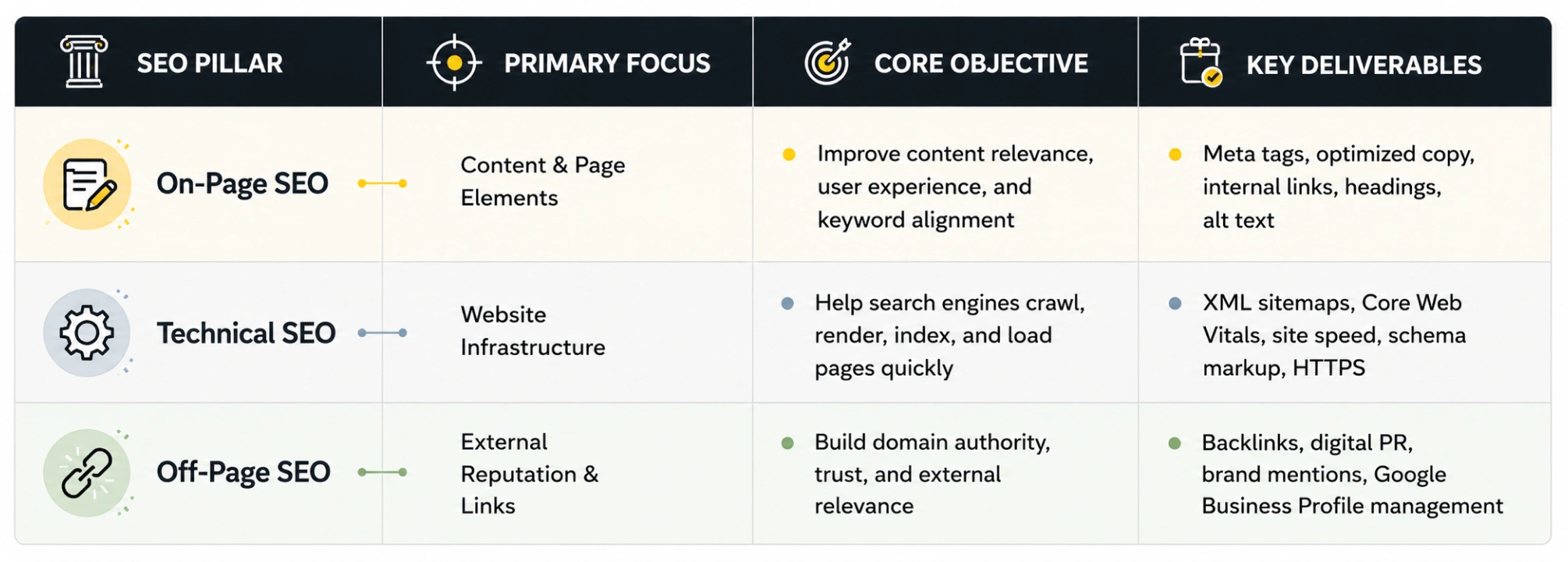
5. On-Page vs Technical vs Off-Page SEO: Key Differences at a Glance
6. How the Three pillars work together
Why does your website still struggle to rank even after publishing high-quality content? Or why do your rankings suddenly drop despite investing in SEO? The answer often lies in a common misconception: treating SEO as a single strategy instead of three interconnected disciplines.
Many businesses focus solely on optimizing content while overlooking technical performance or authority-building efforts. As a result, search engines may struggle to crawl their website, users may leave due to poor experience, or competitors with stronger credibility continue to outrank them.
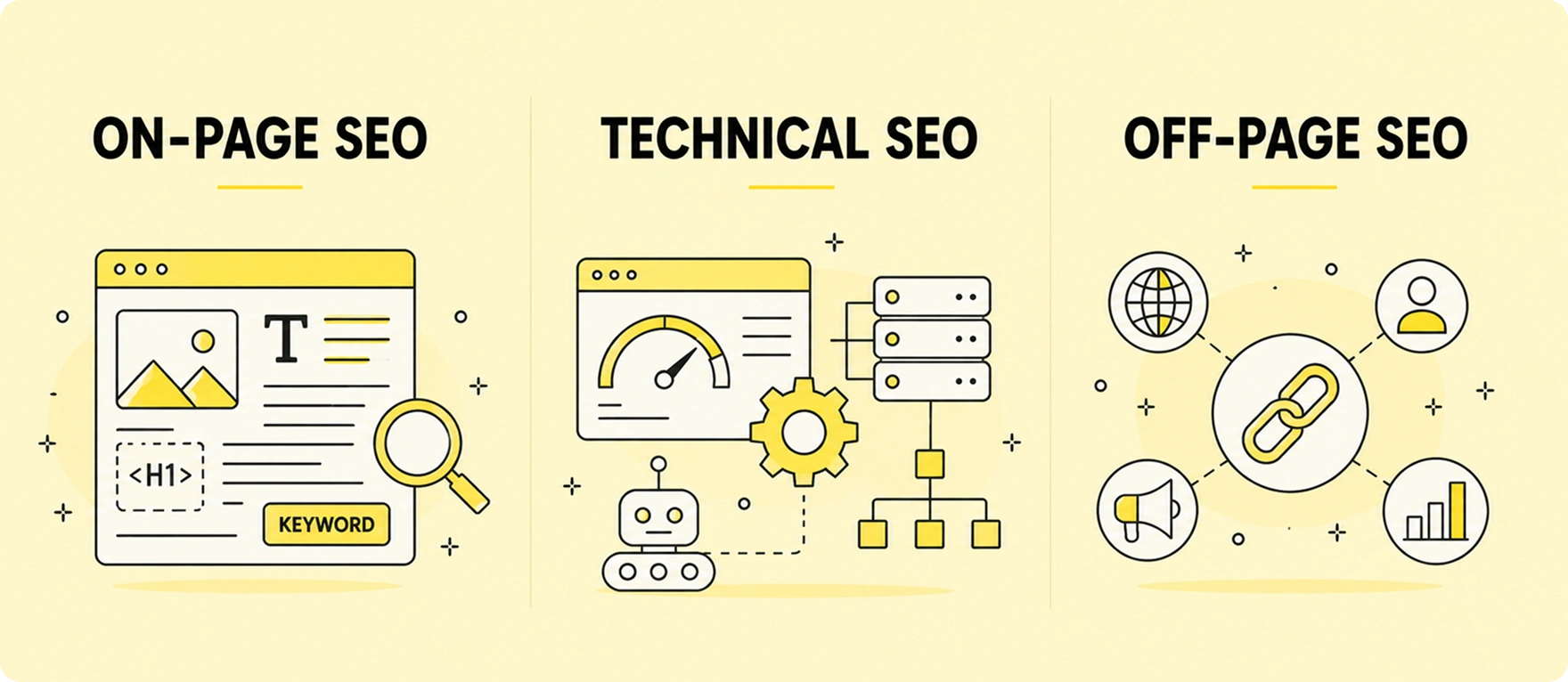
To achieve sustainable organic growth, you need to understand the distinct role each SEO pillar plays. On-Page SEO helps search engines understand your content, Technical SEO ensures your website is fast, secure, and easy to crawl, while Off-Page SEO builds the trust and authority needed to compete for top rankings.
On-Page SEO focuses entirely on the content and elements living directly on your individual webpages. It centers on a single principle: creating valuable content that answers a user’s search intent while signaling to search engine crawlers what your page is actually about.
When you optimize on-page elements, you give search engines clear context while giving human readers a clear, enjoyable browsing experience.
If On-Page SEO is the visual arrangement inside your shop, Technical SEO is the architectural blueprints, plumbing, and electrical system.
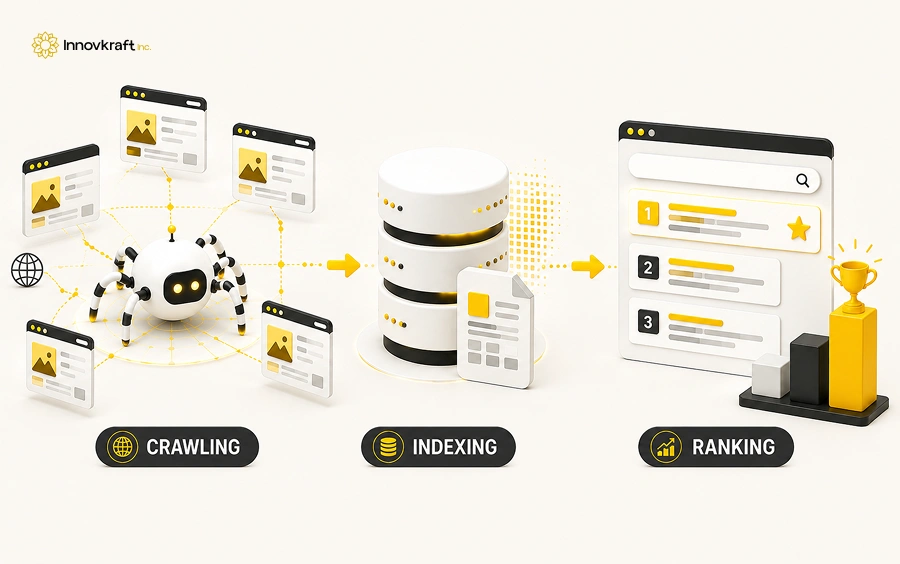
Technical SEO focuses on backend infrastructure. It ensures that search engines can easily access, crawl, render, and index your website without running into structural dead ends or massive performance slowdowns. Even the best content in the world will fail to rank if search engine bots cannot crawl your pages efficiently.
Consider an e-commerce brand launching a flash sale with 10,000 new inventory items. Technical SEO ensures that server bandwidth handles high traffic spikes, duplicate product page variations use canonical tags to avoid self-cannibalization, and search engines index new product URLs immediately without server timeouts.
For fast-scaling enterprises or local businesses competing in tech hubs, fixing backend speed and mobile performance usually yields instant organic visibility gains. Working alongside a dedicated team that offers top-tier SEO services in Bangalore helps brands streamline complex site architectures, fix crawl errors, and maintain lightning-fast page speed across every device.

Off-Page SEO encompasses every action taken outside your website to boost your search engine rankings.
While On-Page and Technical SEO are entirely within your control, Off-Page SEO relies heavily on building genuine relationships, reputation, and authority across the broader web. Search engines view off-page signals as vote-of-confidence endorsements from the rest of the digital world.
A local healthcare clinic posts a medical breakthrough report. A major news network covers the story online and links back to the clinic website as the primary source. That single, high-authority backlink acts as a powerful vote of trust, signaling to Google that the clinic is a legitimate authority in its field.
Executing link acquisition strategies requires careful white-hat outreach to protect site health from algorithm penalties. Many growing organizations partner with specialists providing trusted SEO services in Bangalore to execute high-impact digital PR and acquire natural backlinks from relevant platforms.
Here is a simple scenario showing why all three pillars are essential:
Conversely, if your technical performance is flawless and you have hundreds of backlinks, but your content is thin, outdated, or filled with keyword stuffing, visitors will bounce immediately. Google will quickly drop your rankings.
For companies aiming to capture competitive market share, executing all three disciplines simultaneously is essential. Local and global brands often hire professional agencies providing end-to-end SEO services in Bangalore to balance backend technical audits with high-converting content creation and link-building campaigns.

If you are launching a new website or fixing a struggling old site, follow this logical sequence:
Whether you run an online retail store or an enterprise B2B company, maintaining a steady flow of organic leads requires consistent effort across all three areas. Many expanding software startups rely on specialized SEO services in Bangalore to handle this continuous cycle of site maintenance, keyword optimization, and authority building.
Picking the right mix of technical fixes, content updates, and external promotion keeps your organic growth compounding over time, giving your business a lasting advantage over the competition.
Mastering search engine optimization comes down to balance: On-Page SEO delivers value, Technical SEO ensures fast access, and Off-Page SEO builds authority. By balancing all three, or partnering with experts offering top-tier SEO services in Bangalore, your business can secure durable, top-tier rankings that drive real growth.
Ready to turn your website into a powerful growth engine? Innovkraft combines strategy, creativity, and data-driven execution to help businesses achieve measurable digital success. Get in touch with our team today and take the next step towards smarter growth.