Read time : 6 min
Share:
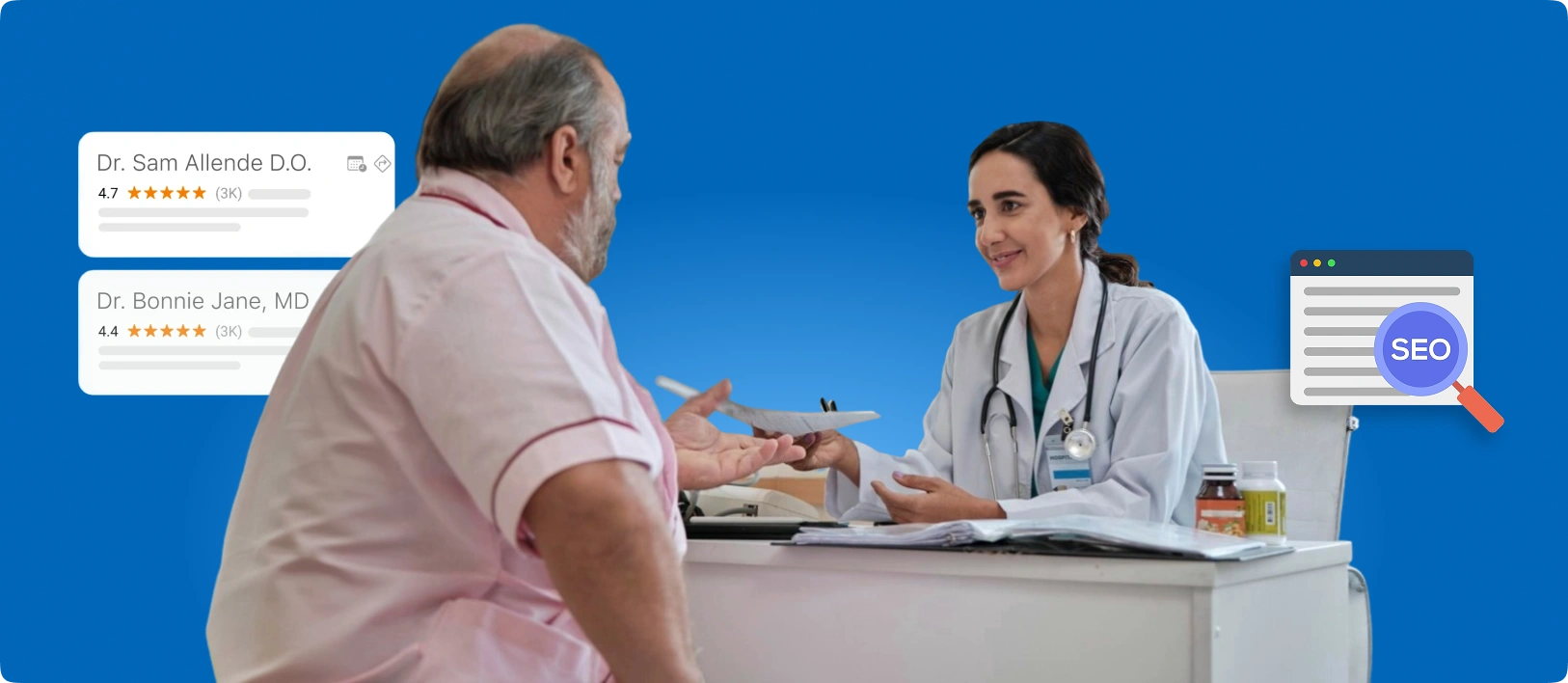
Last year, Google processed over 1 billion health-related searches every single day. One billion. Now here is the most shocking part: most of those clicks went to whoever showed up on page one.
Not the most experienced cardiologist, pediatrician or even the hospital with the best surgical outcomes.
Just the most visible. If that feels unfair, you are not alone. In healthcare brands where senior doctors had decades of experience, yet their appointment calendars were not full.
Meanwhile, newer clinics with aggressive digital were ranking above them. That is when the reality becomes clear:
Google does not care how great your doctors are. It cares how clearly your expertise is structured, optimized, and presented online. And that is exactly where SEO changes the intent.
Imagine two orthopedic clinics in the same city.
Clinic A has senior surgeons, advanced imaging equipment, and a long-standing reputation. Clinic B is newer, smaller, and less established, but appears on page one for:
Which clinic gets more calls? Clinic B.
Not because it is better medically, because it is structured better digitally.
Search engines rank based on signals they can measure. Those signals include page relevance, content depth, technical performance, keyword alignment, and authority indicators.
They do not rank based on surgical outcomes unless those outcomes are structured into content Google can interpret. That is the difference.
This is where many healthcare websites fail.
Doctors describe services in professional, clinical language. Patients search in everyday language.
A cardiologist may say, “Interventional coronary artery management.” A patient types, “Chest pain treatment near me.”
A gynecologist may say, “Polycystic ovarian syndrome endocrine management.” A patient types, “PCOS doctor in Delhi.”
If your website content uses only clinical terminology, you are invisible to patient-intent searches.
SEO works by aligning professional expertise with real-world search behavior. It does not simplify medicine, instead it translates it.
When your website contains structured pages that explain conditions in accessible, medically accurate language, Google connects your expertise with patient queries.

Google ranks individual pages for specific search queries. If you want to rank for “angioplasty cost in Mumbai,” you need a page dedicated to angioplasty.
Not a single cardiology page mentioning it once. A well-optimized healthcare website includes:
Healthcare decisions are local. When someone searches “ENT specialist near me,” Google prioritizes map listings before regular websites.
If your Google Business Profile is incomplete, inconsistent, or inactive, you are automatically at a disadvantage.
Local SEO involves ensuring:
For example, a review that says: “Dr. Patel treated my chronic sinus infection in Ahmedabad. Clear explanation and effective medication.”
That review strengthens:
Here is something many hospitals underestimate: page speed.
If your website takes four seconds to load on mobile, many users leave before reading anything. Google tracks that behavior.
Slow websites, broken links, poorly structured URLs, missing meta descriptions, and lack of structured schema markup quietly damage rankings.
Technical SEO ensures that:
Healthcare content falls under strict evaluation standards because it impacts health decisions.
Google assesses your:
If your website does not clearly display doctor qualifications, years of experience, specializations, hospital affiliations, certifications and publications or recognitions.
Then your authority signals are weak.
Your website must present structured doctor profile pages with detailed credentials.
Not just a short paragraph saying “Dr. Sharma is a renowned specialist.” That statement means nothing to an algorithm. Specificity builds credibility.

They search:
“Is persistent headache serious?”
“How long is recovery after hernia surgery?”
“Thyroid weight gain treatment options”
If your website answers these questions in clear, medically accurate language, you gain early trust.
Educational content serves two purposes:
For example, a blog explaining “Early Signs of Thyroid Disorder” can link to your endocrinology consultation page. That internal connection strengthens both SEO and patient journey flow.
It is not about publishing random articles. It is always about building structured knowledge ecosystems around your specialties.
Here is the part many healthcare leaders misunderstand. SEO is not a promotion; it is digital infrastructure. If your clinic is not visible online, patients searching for help may never discover you. That is not just a marketing gap, it is an accessibility gap.
When implemented correctly, SEO:
Healthcare has always been built on trust, expertise, and patient outcomes. But the way patients discover that trust has changed. The first interaction no longer happens at your reception desk. It happens on a search results page.
When your website clearly explains your services, your doctor credentials are transparently presented, your content answers real patient questions, and your local presence is optimized, Google begins to recognize what your patients already know.
At Innovkraft, we build healthcare-focused SEO systems that are strategic, compliant, and performance-driven. We understand the sensitivity of medical content, the importance of E-E-A-T, and the technical precision required to compete in health search rankings.
Let’s fix what Google is missing. Schedule your SEO audit in under 2 minutes.