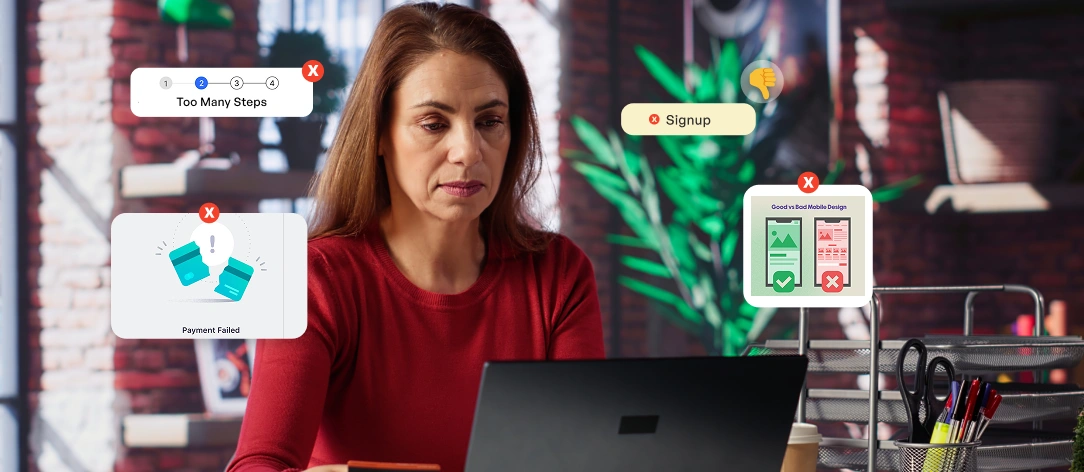
Most e-commerce brands invest a lot in advertising to attract visitors, build interest in their products, and guide potential customers toward making a purchase. However, the actual problem begins when they are at checkout. This is the final step, where intent often meets obstacles – and this is the step where most brands lose nearly 80% of shoppers. Most shoppers do not leave because they have changed their minds about the product: they leave because the checkout process doesn’t meet their expectations. To reduce friction and turn high-intent shoppers into customers, brands must identify the causes of abandonment and how data-driven CRO strategies can help solve them effectively.
The need to create an account before making a purchase is the major reason for instant drop-off. New customers, especially those who are first-time, view this as an unwelcoming promise. They are willing to make purchases but don’t want to have a long-term relationship with the brand. The forced registration, verification, or the need to create a password disrupts their flow. This interruption at a crucial moment often leads them to abandon their cart and seek a faster, more convenient option.
Another major reason for drop off is when customers unexpectedly see shipping costs, taxes, or other charges only at the last-minute results in the brand losing trust. Although these costs can be valid, exposing them late makes shoppers feel deceived. The emotional impact of the surprise charges is high, as the shopper has already set their expectations regarding the price. When the total amount suddenly increases, it appears unreasonable to make a purchase, and most people abandon their carts. It is not the price, but the timing that matters.
Different customers have varying preferences for payment methods, and a checkout that doesn’t offer these options leads to immediate abandonment of the cart. Shoppers prefer to pay with the tool they are most confident in, be it UPI, mobile wallets, BNPL, or COD. In the absence of their preferred option, they feel uncertain and are likely to leave rather than adjust. When brands fail to offer flexibility in payment options, they tend to lose sales to competitors.
Lengthy checkout forms that drain shoppers are another major reason that makes them give up their carts. Customers become impatient when they have to fill in too many fields, enter the same information several times, or complete multiple forms. Customers demand fast and easy shopping. Friction caused by the absence of autofill options, ambiguous progress indicators, or irrelevant questions does not fit in a fast-paced online environment. When the process starts to feel overwhelming, shoppers tend to quit instead of continuing.
speed plays a vital role at checkout: unresponsive buttons, slow loading pages, or slow confirmation of payment lead to loss of trust. Customers fear paying twice or making mistakes, particularly the mobile users who are transacting in the background. A slow or frozen checkout system appears untrustworthy, and customers will automatically withdraw themselves when it does not appear to be technically viable to process their payments
since the majority of e-commerce traffic is through mobile devices, any non-optimized checkout will result in high levels of abandonment. Cluttered design, small input fields, and the absence of autofill can cause friction. Mobile shoppers tend to visit in a limited time and space, and whether it is poor design or poor interaction, this is a break in their flow. An efficient checkout via mobile leads to instant exits.
Consumers need to be given a definite guarantee that their payment and personal information are safe. The lack of trust features such as an SSL indicator, a secure payment badge, a transparent refund policy, or simple access to the support information leads to uncertainty. Checkout is a risky time, and any doubts about the security can make customers leave their purchases.
Before seeing how it helps fix the problem, it’s important to understand what CRO actually is. Conversion rate optimization (CRO) is the technique of data analysis that examines how actual users navigate the checkout process – where they hesitate, where they encounter obstacles, and what prompts them to leave. CRO does not rely on assumptions but uses analytics, heatmaps, user recording, and A/B testing to identify friction points. It then drives improvements to make the experience smoother, faster, and more intuitive. CRO helps fix checkout drop-offs in the following ways:
CRO assesses where and how additional costs are disclosed. This feature is beneficial as it ensures that all shipping fees, taxes, and supplementary charges are displayed promptly, avoiding last-minute surprises for customers. This transparency builds a level of trust and ensures that the customers enter the checkout with the right expectations.
CRO streamlines the entire checkout process by eliminating unnecessary fields and reducing the steps for completion. It identifies distracting or unnecessary parts and converts them into a quick, user-friendly experience. A streamlined process retains the customers and facilitates their transition from cart to order confirmation without obstacles
CRO helps brands understand the payment options that customers prefer the most and provides them with a wider range of payment options. Offering recognized and trusted payment options—aligned with both local and global trends—is crucial for boosting customer comfort and significantly increasing checkout completion rates.
CRO determines technical issues, like slow scripts, heavy pages, or unreliable payment gateways, and manages to fix them. Faster, more efficient checkout Web pages create confidence and reduce stress about financial transactions. When customers are confident that everything functions properly, they are more likely to finalize their purchase without worrying about errors.
Since mobile shoppers make up a significant portion of online buyers, CRO focuses on ensuring that they have a smooth checkout experience on their mobile phones. This includes minimization of layouts, optimization of tap targets, use of autofill, and simplifying navigation.
CRO will install security indicators such as locking systems, badges of trust, and payment and policy links at the critical stages of the checkout process. Such indicators will provide the customers with the assurance that their data is safe. Users are much more likely to finalize the transaction when they are sure of their safety.
CRO ensures that the anticipated delivery dates are displayed in front of and at the time of checkout. When the delivery schedules are clear, it lessens uncertainty and helps customers feel assured about completing their order.
CRO helps uncover and prioritize invisible, conversion-blocking bugs, such as slow payment gateways or session timeouts. These issues often go unnoticed but significantly contribute to checkout drop-offs. Once identified, teams can resolve them to create a smoother, more reliable checkout experience.
Checkout abandonment does not occur because the person is not interested in the product, but is caused by friction, confusion, or lack of trust in the checkout page. Customers are likely to move away when they are forced to create an account, or when they experience unexpected charges/costs, slow loading, limited payment options, and even uncertainty in security. Conversion Rate Optimization (CRO) is a data-driven, systematic way of dealing with these challenges and helping customers complete their purchases in a smooth and more efficient way. CRO helps brands retain more customers and build long-term loyalty by streamlining, increasing transparency, mobile-optimizing, and making technical improvements.